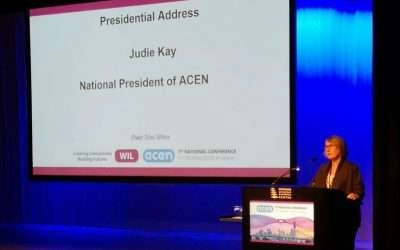
The provided document is the proceedings of the **Australian Collaborative Education Network (ACEN) 2018 National Conference** held in Brisbane, Queensland, from October 3rd to October 5th, 2018
**Key Information from the Proceedings:**
* **Conference Theme:** WIL: Creating Connections, Building Futures
* **Conference Host and Partners:** Hosted by Griffith University, QUT, and The University of Queensland. Partners included InPlace, Practera, Readygrad, MONASH University, Study Queensland, and the Queensland Government
* **Review Process:** All full papers were independently blind peer-reviewed by at least two reviewers, with consideration for HERDC reporting requirements.
* **Editors:** Judith Smith, Karen Robinson, and Matthew Campbell * **ISBN:** 978-0-9805706-4-9
* **Sub-themes:** Managing and building relationships, embedding employability, quality dimension of WIL, capability building and recognition, the future of WIL, and creating connections within and across disciplines
**Summaries of Selected Papers (Full Papers):**
* **"Embedding learner autonomy in future employability: International case studies"** (Bandaranaike et al.): Compared changes in student-perceived levels of learner autonomy in Work Integrated Learning (WIL) across Australia, Mexico, and Thailand using the Work Skills Development (WSD) Framework. The study found a significant (p≤0.01) increase in autonomy post-placement. The level of autonomy was influenced by training facilities, resources, motivation, cultural background, and mentoring
* **"Developing generic skills through a new Flagship Internship"** (Bouilheres et al.): Evaluated the Flagship Internship Project (FIP) at RMIT University Vietnam. An online survey of 40 alumni found the project's main contributions, through exploratory factor analysis, were **Collaboration and accountability** (M=4.23) and **Self-improvement in the workplace** (M=4.18)
* **"In hosts, we trust: Examining how WIL academics form mutual trust with industry through dialogic communication"** (Burley): Examined how WIL academics build relationships with industry through dialogic communication and trust. Mutual trust is formed through legitimisation of expertise, understanding organisational culture, and the academic acting as a **boundary spanner** to mediate shared meaning and goals. This process is cyclical and also involves ethical, aim-oriented, and outcome-oriented trust
* **"Beyond employability: Conceptualising WIL in postgraduate education"** (Campbell et al.): Argues that WIL in postgraduate settings should move beyond simple employability to encompass professional and personal transformation and identity formation. Two case studies (Engineering Management and Mental Health Practice) demonstrated the transformative power of project-based and praxis-based WIL models.